

 Sign-In
 Cart
Cart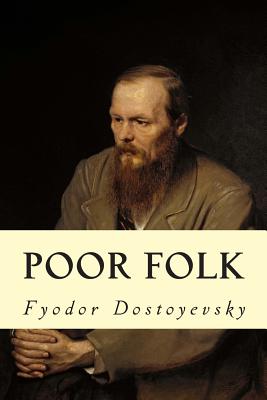
Poor Folk
Paperback
Classic FictionGeneral Fiction
Please select the version of book you would like to purchase.
ISBN10: 1502367009
ISBN13: 9781502367006
Publisher: Createspace
Published: Sep 19 2014
Pages: 132
Weight: 0.41
Height: 0.28 Width: 5.98 Depth: 9.02
Language: English
ISBN13: 9781502367006
Publisher: Createspace
Published: Sep 19 2014
Pages: 132
Weight: 0.41
Height: 0.28 Width: 5.98 Depth: 9.02
Language: English
Poor Folk is sometimes translated as Poor People, is the first novella by Fyodor Dostoyevsky, written over the span of nine months between 1844 and 1845. Dostoyevsky was in financial difficulty because of his extravagant living and his developing gambling addiction; although he had produced some translations of foreign novels, they had little success, and he decided to write a novel of his own to try to raise funds. Inspired by the works of Gogol, Pushkin, and Karamzin, as well as English and French authors, Poor Folk is written in the form of letters between the two main characters, Makar Devushkin and Varvara Dobroselova, who are poor second cousins. The novel showcases the life of poor people, their relationship with rich people, and poverty in general, all common themes of literary naturalism. A deep but odd friendship develops between them until Dobroselova loses her interest in literature, and later in communicating with Devushkin after a rich widower Mr. Bykov proposes to her. Devushkin, a prototype of the clerk found in many works of naturalistic literature at that time, retains his sentimental characteristics; Dobroselova abandons art, while Devushkin cannot live without literature. Contemporary critics lauded Poor Folk for its humanitarian themes. While Vissarion Belinsky dubbed the novel Russia's first social novel and Alexander Herzen called it a major socialist work, other critics detected parody and satire. The novel uses a complicated polyphony of voices from different perspectives and narrators. Initially offered by Dostoyevsky to the liberal-leaning magazine Fatherland Notes, the novel was published in the almanac, St. Petersburg Collection, on January 15, 1846. It became a huge success nationwide. Parts of it were translated into German by Wilhelm Wolfsohn and published in an 1846/1847 magazine. The first English translation was provided by Lena Milman in 1894, with an introduction by George Moore, cover art design by Aubrey Beardsley and publication by London's Mathews and Lane. Varvara Dobroselova and Makar Devushkin are second cousins twice-removed and live across from each other on the same street in terrible apartments. Devushkin's, for example, is merely a portioned-off section of the kitchen, and he lives with several other tenants, such as the Gorshkovs, whose son groans in agonizing hunger almost the entire story and eventually dies. Devushkin and Dobroselova exchange letters attesting to their terrible living conditions and the former frequently squanders his money on gifts for her. The reader progressively learns their history. Dobroselova originally lived in the country, but moved to St. Petersburg (which she hates) when her father lost his job. Her father becomes very violent and her mother severely depressed. Her father dies and they move in with Anna Fyodorovna, a landlady who was previously cruel to them but at least pretends to feel sympathy for their situation. Dobroselova is tutored by a poor student named Pokrovsky, whose drunken father occasionally visits. She eventually falls in love with Pokrovsky. She struggles to save a measly amount of money to purchase the complete works of Pushkin at the market for his birthday present, then allows his father to give the books to him instead, claiming that just knowing he received the books will be enough for her happiness. Pokrovsky falls ill soon after, and his dying wish is to see the sun and the world outside. Dobroselova obliges by opening the blinds to reveal grey clouds and dirty rain. In response Pokrovsky only shakes his head and then passes away. Dobroselova's mother dies shortly afterwards, and Dobroselova is left in the care of Anna for a time, but the abuse becomes too much and she goes to live with Fedora across the street.
Also in
Classic Fiction
James Fenimore Cooper: The Leatherstocking Tales Vol. 1 (Loa #26): The Pioneers / The Last of the Mohicans / The Prairie
Cooper, James Fenimore
Hardcover
From $19.99
Four Comedies: The Taming of the Shrew, a Midsummer Night's Dream, the Merchant of Venice, Twelfth Night
Shakespeare, William
Paperback
From $5.99
The Princess Bride Deluxe Limited Edition: S. Morgenstern's Classic Tale of True Love and High Adventure
Goldman, William
Paperback
$19.80
The Fellowship of the Ring: Being the First Part of the Lord of the Rings
Tolkien, J. R. R.
Paperback
$17.99
The Lord of the Rings Illustrated by the Author: Illustrated by J.R.R. Tolkien
Tolkien, J. R. R.
Hardcover
$81.00
The Princess Bride: S. Morgenstern's Classic Tale of True Love and High Adventure
Goldman, William
Hardcover
$38.00
The Pilgrim's Progress: A Readable Modern-Day Version of John Bunyan's Pilgrim's Progress (Revised and easy-to-read)
Bunyan, John
Vermilye, Alan
Paperback
$15.19
Frankenstein, Dracula, Dr. Jekyll and Mr. Hyde
Stevenson, Robert Louis
Stoker, Bram
Shelley, Mary
Paperback
$9.45