

 Sign-In
 Cart
Cart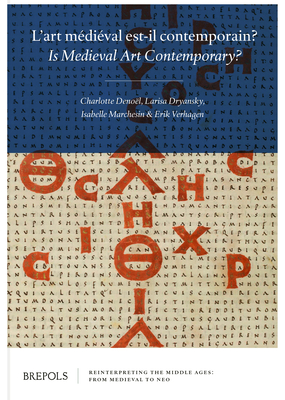
L'Art Medieval Est-Il Contemporain?: Is Medieval Art Contemporary?
Hardcover
Series: Reinterpreting the Middle Ages, Book 1
Currently unavailable to order
Please enter your email and a message will be sent to you when this product becomes available on our website.
ISBN10: 2503599737
ISBN13: 9782503599731
Publisher: Brepols Publishers
Published: Apr 13 2023
Pages: 247
Weight: 0.31
Language: French
ISBN13: 9782503599731
Publisher: Brepols Publishers
Published: Apr 13 2023
Pages: 247
Weight: 0.31
Language: French
This publication brings together essays by scholars of both medieval and contemporary art, offering a cross-disciplinary approach of both periods. It investigates how contemporary artists and contemporary art historians perceive medieval art, and, reciprocally, how medieval art historians envisage the echoes of medieval artforms and esthetics in contemporary art. The volume follows on from the symposium organized in conjunction with the exhibition Make it New: Carte Blanche a Jan Dibbets that was held at the Bibliotheque Nationale de France (Paris) in 2019, and which presented side by side Hrabanus Maurus's De Laudibus Sanctae Crucis (In Praise of the Holy Cross), a masterpiece of Carolingian art, with works by artists associated with conceptual art, mininimal art, and land art. How and why has medieval art, and particularly early medieval art, inspired contemporary artists since the 1950s? What has medieval art contributed to contemporary art? How has medieval art's treatment of figures, color, space, geometry, and rhythm provided inspiration for contemporary artists' experiments with form? In what way does contemporary artists' engagement with the topics of formatting, writing, semiosis, mimesis, and ornamentation draw inspiration from medieval models? To what extent and in what sense are the notions of authorship and performativity relevant for understanding conceptions of artmaking in both periods? Rather than focusing on medievalism and citational practices, or on the theory of images-both approaches having already produced an important body of comparative readings of medieval and contemporary art-the essays in this volume address the question of medieval art's contemporaneity thematically, through three trans-chronological topics: authorship, semiosis and mathematics, and performance. Engaging the artists' works as well as their writings, these studies conflate conceptual and esthetic perspectives.
Also from
Denoel, Charlotte
Also in
Art History
The Secrets of Art: Uncovering the Mysteries and Messages of Great Works of Art
Mancoff, Debra N.
Hardcover
$24.99
Progressive Design in the Midwest: The Purcell-Cutts House and the Prairie School Collection at the Minneapolis Institute of Arts
Olivarez, Jennifer Komar
Paperback
From $12.99
Sabine's Notebook: In Which the Extraordinary Correspondence of Griffin & Sabine Continues
Bantock, Nick
Hardcover
$10.99
Paint by Sticker (Official): Works of Art: Re-Create 12 Iconic Masterpieces One Sticker at a Time!
Workman Publishing
Paperback
$16.14
Paint by Sticker (Official): Masterpieces: Re-Create 12 Iconic Artworks One Sticker at a Time!
Workman Publishing
Paperback
$18.04
Stupid Faces in Stunning Paintings: A Serious Exploration of Art History's Silliest Expressions
Mierlo, Matthijs Van
Hardcover
$23.74
Oliver Byrne's Elements of Euclid: The First Six Books with Coloured Diagrams and Symbols (Art Meets Science Edition)
Art Meets Science
Hardcover
$59.99
The Art Spy: The Extraordinary Untold Tale of WWII Resistance Hero Rose Valland
Young, Michelle
Hardcover
From $19.99
Paint by Sticker (Official): Portraits: Re-Create 12 Historic Paintings One Sticker at a Time!
Workman Publishing
Paperback
$17.09
Femina: A New History of the Middle Ages, Through the Women Written Out of It
Ramirez, Janina
Paperback
$19.79
Bohemians on the Breadline: The Radical Women Artists of Roosevelt's New Deal
Arrington, Lauren
Hardcover
$27.55
The Art of the Unknown: A Visual Treasury of the Esoteric, Uncanny and Unexplained
Elizabeth, S.
Hardcover
$28.50
The Secrets of Painting: The Hidden Art of the Masterpiece from Prehistory to Today
Goudie, Lachlan
Hardcover
$45.00
Adventures in the Louvre: How to Fall in Love with the World's Greatest Museum
Sciolino, Elaine
Paperback
$19.79
The Short Story of Queer Art: A Pocket Guide to Key Movements, Works, Themes & Breakthroughs
Hoskin, Dawn
Paperback
$21.59
AP Art History Premium, Sixth Edition: Prep Book with 5 Practice Tests + Comprehensive Review + Online Practice
Nici, John B., M. a.
Paperback
$42.74
Van Gogh Has a Broken Heart: What Art Teaches Us about the Wonder and Struggle of Being Alive
Ramsey, Russ
Hardcover
$28.49
The Annotated Mona Lisa, Third Edition: A Crash Course in Art History from Prehistoric to the Present
Strickland, Carol
Paperback
$28.49
Flashes of Brilliance: The Genius of Early Photography and How It Transformed Art, Science, and History
Burgess, Anika
Hardcover
$33.25
The Codex Borgia: A Full-Color Restoration of the Ancient Mexican Manuscript
Rodgers, Alan
Díaz, Gisele
Paperback
$23.70
The Rescue Artist: A True Story of Art, Thieves, and the Hunt for a Missing Masterpiece
Dolnick, Edward
Paperback
$17.99
Weaving at Black Mountain College: Anni Albers, Trude Guermonprez, and Their Students
Thomson, Julie J.
Beggs, Michael
Hardcover
$38.00